

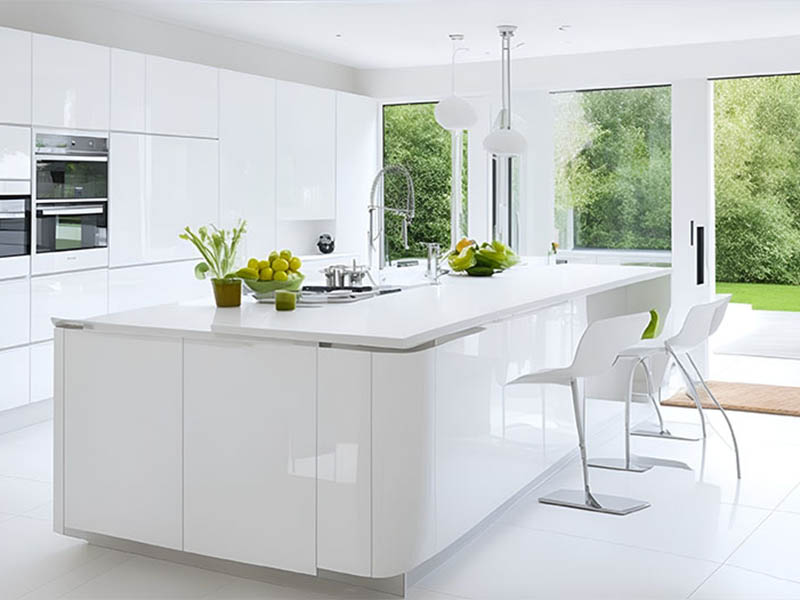
WHITE KITCHENS: a colour that is always in style, for large or small spaces.
White kitchens to furnish any ambience in a “bright” way and advice on how to make the most of the room.
Why choose a white kitchen
The white kitchen is a classic. Timeless, it never goes out of fashion nor does it fall in liking for those who choose it, as the neutral colour makes it a perfect passe-partout in any home and for any furnishing style. White is in fact the colour chosen by companies for the first ‘American’ models, i.e. the modular and industrialised compositions of the 1950s, equipped with the ancestors of our appliances in an exclusively white version.
Why opt for a white kitchen
The ” candour ” of the white kitchen makes these models easy to place: they can easily be combined with a classic living room furnished with wooden furniture or a modern one with very colourful pieces.
White kitchens, whether lacquered or laminate, have a timeless appeal that makes them immune to fashion; they give a bright and fresh feeling thanks to their white surfaces that reflect light. It has to be said, however, that there is white and white: from cream-coloured to ice-white, the shades are many, available in glossy or matt variants.
Bright and fresh, a total white kitchen, with its tidy and elegant appearance, can be placed in the most diverse environmental contexts, from the studio to the large flat, from the classic style home to the contemporary loft. Contemporary models, characterised by smooth lines and surfaces, are the ideal solution for modern kitchens that open directly into the living room, which can therefore be in any finish without creating any conflict or dissonance between the two environments.
To warm up the composition, simply introduce a few elements in wood, with visible veins that enhance the material aspect.
White kitchens are gifted with timeless elegance and have the advantage of not weighing down the room even in the case of large models. If the composition is set against walls that are themselves white, a space-expanding effect is created, while a contrasting colour scheme clearly defines the boundaries of the room. The choice of accessories contributes to accentuating the style of the kitchen itself: in wood for the Provencal, in steel for the high-tech, in soft colours for a pop effect.
Another advantage of the white kitchen is that you can easily change the background creating a real relooking of the room.
What material can I use for my white kitchen?
The white kitchen can be made of lacquered wood or glass (the most precious), laminate, polymeric, melamine, pvc. The white finish, however, in addition to the wood panels (lacquered or covered in laminate, polymer or PVC), can be achieved by painting on materials such as stainless steel, aluminium or glass.


How many types of white are there?
There are many shades of white: optical white, chalk white, ice white, cream white, pearl white, lime white… and depending on whether it is one or the other, it is advisable to always use the same type for other elements (walls, windows, doors, other furniture… ).
Pure white
The white kitchen for excellence is the one with white, smooth doors, devoid of any fuss. The minimalist appearance, however, often conceals sophisticated details: grooves for the opening of doors and drawers, accessories and mechanisms such as handles or hinges, connections with the materials of the worktop such as shutters or joints. The smooth door, with a glossy or matt finish depending on taste, emphasises the sculptural presence of the storage volumes, as well as the technology of the large appliances. And it can be invigorated by the combination with materials with more chromatic textures, such as steel, wood essences, coloured composites, and material solid surfaces.
Black and white optical
A further possibility when choosing a white kitchen can be to opt for the so-called optical style, a term derived from fashion indicating a sharply contrasting combination of black and white. Whether it is the door frame, the plinth finish or the colour of the worktop that adds the black touch, the result is always particularly expressive. Even more so if you want to tend towards vintage, leaning towards either the 1950s or industrial taste.
White kitchen also in a classic version
A white kitchen in a classic version makes the composition less cloying than the choice of visible wood. White framed doors can in fact suggest an aesthetic derived from tradition. Open-pore lacquered, to allow a glimpse of the wood grain, or not – whether matt or glossy – the kitchen becomes brighter than a model in wood, suitable even for small rooms. A good solution, moreover, for those who do not wish to renounce the warmth and cosiness of the classic style, but have the rest of their home furnishings in a modern taste. All the more so if you opt for a composition without handles, with grooves integrated in the door that give an additional modern accent to the whole.
What colours to match a white kitchen?
That no colour looks bad next to white is a well-known fact. However, it should be pointed out that combining only neutral tones with it may not be the best solution. The white kitchen environment should therefore include some elements that create a nice contrast: warm parquet flooring, decorative tiles, resin-covered surfaces in dark colours, bright paints or at least in intense and strong tones, wallpaper coverings with a strong effect… or some elements of the kitchen itself (the worktop, a module with open compartments, a wall paneling…). In order to personalise these compositions, it is necessary to focus on targeted details, such as contrasting colour modules if the aim is to liven things up. Or simple black profiles to emphasise rigorous style and graphic play. To add a chromatic note, even in an existing kitchen, simply add one or more shelves. They are also small in size: they easily fit on a small portion of the wall and can be integrated over time. However small, they are always useful for storing jars, cups, glasses and books.
‘Warming’ the white kitchen with wood
The combination of white and wood creates a discreet yet sophisticated ambience. The latest trends feature natural oak, a precious wood with a honey-yellow tone, which does not encumber compositions and can easily be combined with different nuances. It is a wood that is also often used for parquet: another point in its favour, because it allows for stylistically and chromatically balanced furnishing solutions. A ‘living’ material, it can change colour over time when exposed to sunlight. But there is also the décor alternative, unalterable and more economical, which can be achieved with different types of laminate.
How to enliven a white kitchen with contrasting modules
In a white kitchen, excellent results can be achieved by inserting elements of the same composition in wood, coloured lacquer or contrasting material surfaces, e.g. an entire island, the worktop, a group of wall units or tall cabinets, a dramatic wood-effect hood or coloured grooves in another colour in the room.
With strongly contrasting or highly decorative floors and walls
Floors and walls can also be played on tones that enhance the white kitchen: warm wood panelling, dark floor tiles, cement-effect ceramics or cementine and azulejos, super-decorative wall coverings that the current trend continues to reward according to the new motto more is more. A softer solution, compared to covering an entire wall in ceramics with a strong aesthetic value, is to delimit the surface, providing for a part of the wall more neutral collections with the vocation of passe-partout. The furniture will stand out at its best on a painted wall surface or even on a floor, in a dark (greys and browns are very trendy) or bright and vivid colour. Special decorative effects can be achieved not only with normal water paints but also with stucco and resins.
To give dynamism to the room, the advice is to choose a colour to play on by contrast. The colour can then be “entrusted” to a wall (or perhaps to a portion of it), to the floor or to the doors of a conspicuous part of the kitchen itself, e.g. the wall units or the peninsula or the table, but also to accessories, chandeliers or, for example, hoods, if you choose particularly decorative models with an important scenic presence.
Natural and artificial light in the white kitchen
The choice of white amplifies the brightness of the room (and among other things conveys a sense of cleanliness and hygiene), but for the kitchen to be functional and harmonious, strategic artificial lighting is required, which responds to a plurality of needs. First of all, the general lighting must be considered: one or more central lighting points are needed, to be combined with floor and wall lights in the case of open kitchens. As far as the working area is concerned, on the other hand, it is essential to illuminate the work surface well: for in-line compositions LED strips are ideal, while over islands and peninsulas pendant lamps are required. The same type of lighting also for the table, possibly with a direct light source. On the hob, the light provided by the hood is generally sufficient, but if an additional one is needed, battery-operated LED strips are the most immediate solution.
